> For the complete documentation index, see [llms.txt](https://docs.telm.ai/telmai/llms.txt). Markdown versions of documentation pages are available by appending `.md` to page URLs; this page is available as [Markdown](https://docs.telm.ai/telmai/connect-to-data/data-connections/sql-server.md).
# SQL Server
SQL Server can be hosted on prem or run in Azure, GCP or AWS.
## Creating a connection
To connect to SQL Server, you'll need to provide the below details:
{% hint style="info" %}
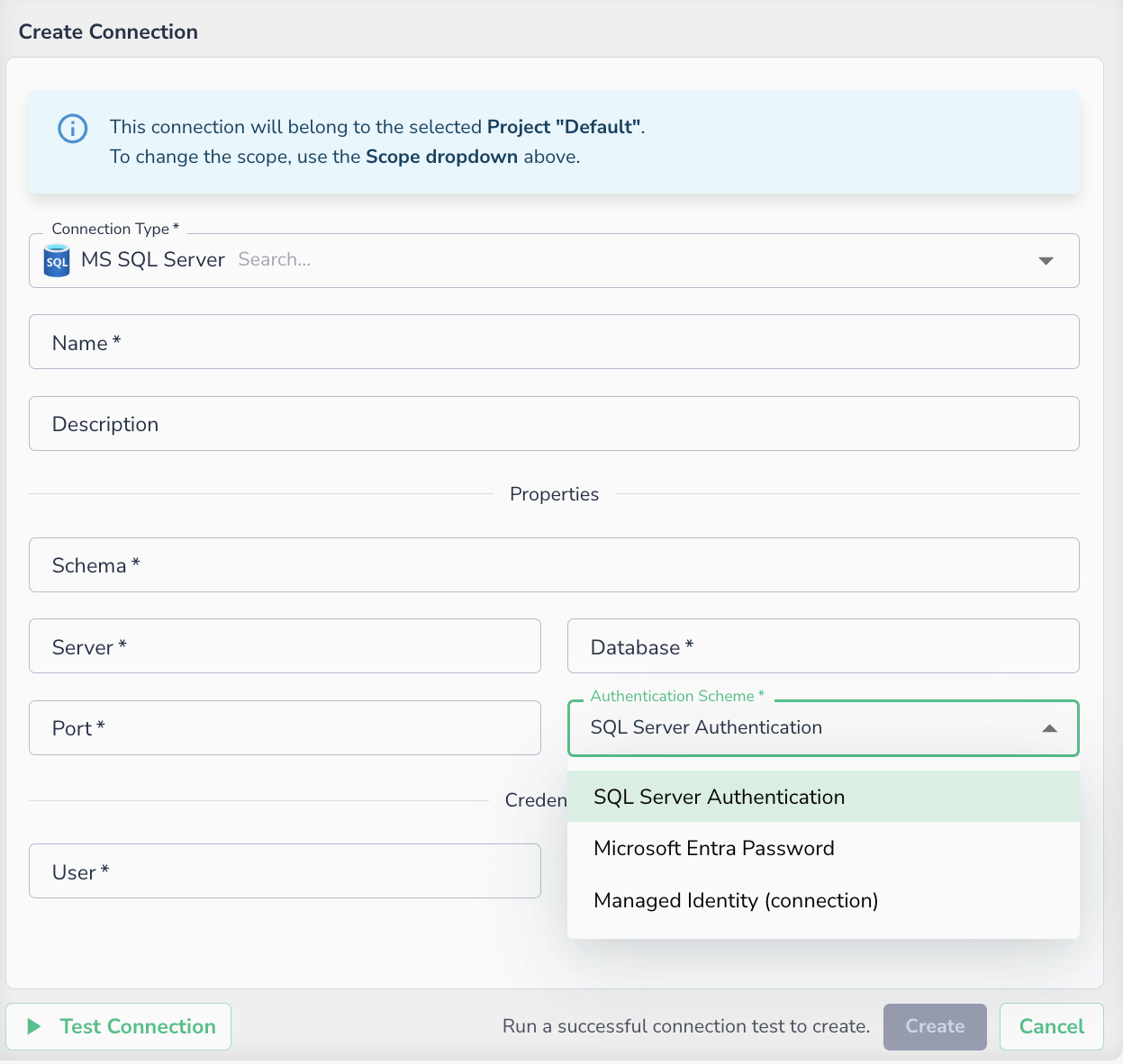
Fill in following details in the form. We use Azure SQL service as an example here:
{% endhint %}
1. **Connection Type**: MS SQL Server
2. **Name**: A name for the connection
3. **Description**: An optional description
4. **Schema**: The schema to connect to
5. **Server**: The server name. It can be found in Azure Portal: *SQL Server -> Server Name -> Overview -> Server Name*
6. **Database**: The database name. This can be found in the Azure Portal at the following location: *SQL Server -> Server Name -> Overview -> Available Resources -> (x) databases*.
7. **Port**: The server port, typically `1433`
8. **Authentication Scheme**: How Telmai authenticates to the server — see [Authentication schemes](#authentication-schemes) below
9. **User** and **Password**: The credentials, when the selected scheme requires them
Creating an MS SQL Server connection, with the Authentication Scheme list open.
Select **Test Connection** to validate the details. The connection can only be created once a test succeeds.
### Authentication schemes
| Scheme | What it uses |
| ----------------------------- | --------------------------------------------------------------------------------------------------------------------------------------------------------------------------------------------------------------------------------------------------------------------------- |
| SQL Server Authentication | A SQL Server username and password, stored on the connection |
| Microsoft Entra Password | A Microsoft Entra username and password, stored on the connection |
| Managed Identity (connection) | A managed identity registered by a Telmai administrator — no user or password is stored. Available on Azure-based Telmai deployments only; see [Azure SQL Server: Managed Identity Authentication](/telmai/connect-to-data/data-connections/sql-server-managed-identity.md) |
{% hint style="info" %}
Note:
* The **User** and **Password** fields apply to the SQL Server Authentication and Microsoft Entra Password schemes. Managed Identity (connection) replaces them with an identity picker and stores no password at all.
* In order to connect to a privately hosted instance, the customer will need to whitelist the IPs from Telmai. Please reach out to Telmai support for the updated list of IP’s for whitelisting.
{% endhint %}
## Connecting an asset
Once a connection is defined, you can start using it to create assets. To create assets, you will need to select existing table, or run a custom SQL query.
{% hint style="warning" %}
JSON data type is not supported for SQL Server connections out of the box. Please reach out to Telmai support if it needs to be enabled
{% endhint %}
{% hint style="info" %}
Please ensure that your environment has whitelisted [Telmai IP list](/telmai/api-reference/telmai-ip-list.md).
{% endhint %}