> For the complete documentation index, see [llms.txt](https://docs.telm.ai/telmai/llms.txt). Markdown versions of documentation pages are available by appending `.md` to page URLs; this page is available as [Markdown](https://docs.telm.ai/telmai/connect-to-data/data-connections/databricks.md).
# Databricks
## Creating a connection
To connect a Databricks table to Telmai, you'll need to gather specific information from your Databricks instance. Follow the steps below:
### **Capture Connection Details.**
You can find the JDBC connectivity details in the Databricks workspace console:
Navigate to **Compute** -> **Cluster** -> **Cluster Name** -> **Configuration** -> **Advanced Options** -> **JDBC/ODBC**.
Capture the following details:
* **Server Hostname**
* **Port**
* **HTTP Path**
For more information, refer to the : [Databricks ODBC and JDBC Drivers](https://docs.databricks.com/integrations/bi/jdbc-odbc-bi.html)
### **Generate a Security Token**
A security token is required to connect to the cluster remotely. Create this token from the Databricks workspace console:
* Go to the top right corner and click on your **User Name** -> **User Settings** -> **Access Token** -> **Generate New Token**.
* Capture the token created.
For detailed instructions, see the[Authentication for Databricks tools and APIs](https://docs.databricks.com/dev-tools/api/latest/authentication.html#token-management)
### Create a connection in Telmai
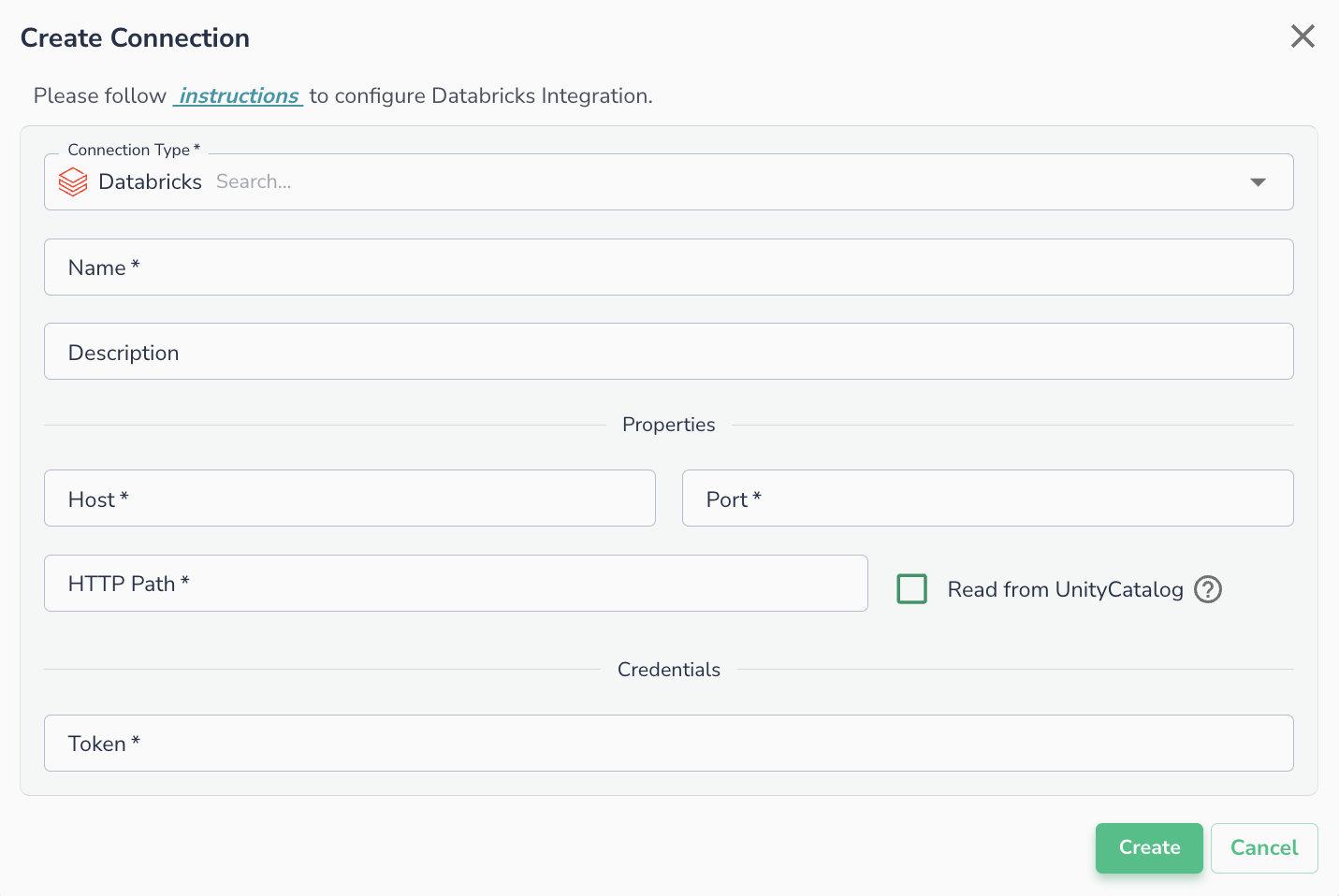
Once you have the necessary information, navigate to the "Connections" page, click +New Connection, select databricks, and enter the following properties:
* **Host:** Cluster hostname
* **Port:** Cluster port
* **HTTP path:** HTTP path of the cluster
* **Token:** API token
* **Read from UnityCatalog:** A flag that enables spark job to read from UnityCatalog directly. This option will only work in case of using Databricks for Telmai-Spark jobs.
{% hint style="warning" %}
Only use "Read from UnityCatalog" if running Telmai jobs in Databricks and provide access to Telmai service account to the data being accessed. Otherwise, data scans will fail.
{% endhint %}
## Connecting an asset
Once a connection is defined, you can start using it to create assets. To create assets, you will need:
* **Schema:** Schema name (i.e., database name)
* **Catalog (Optional):** Unity catalog name
Alternatively, you can run a SQL query