> For the complete documentation index, see [llms.txt](https://docs.telm.ai/telmai/llms.txt). Markdown versions of documentation pages are available by appending `.md` to page URLs; this page is available as [Markdown](https://docs.telm.ai/telmai/integrations/catalog-integration/zeenea.md).

# Zeenea

Telmai integrates with [Zeenea](https://zeenea.com/) to connect data quality monitoring with your Zeenea data catalog. Zeenea metadata enriches Telmai's monitoring configuration and AI-powered recommendations, helping your team discover, prioritize, and monitor critical datasets faster.

## Overview

Telmai pulls the following metadata from Zeenea:

| Metadata type               | How Telmai uses it                                              |
| --------------------------- | --------------------------------------------------------------- |
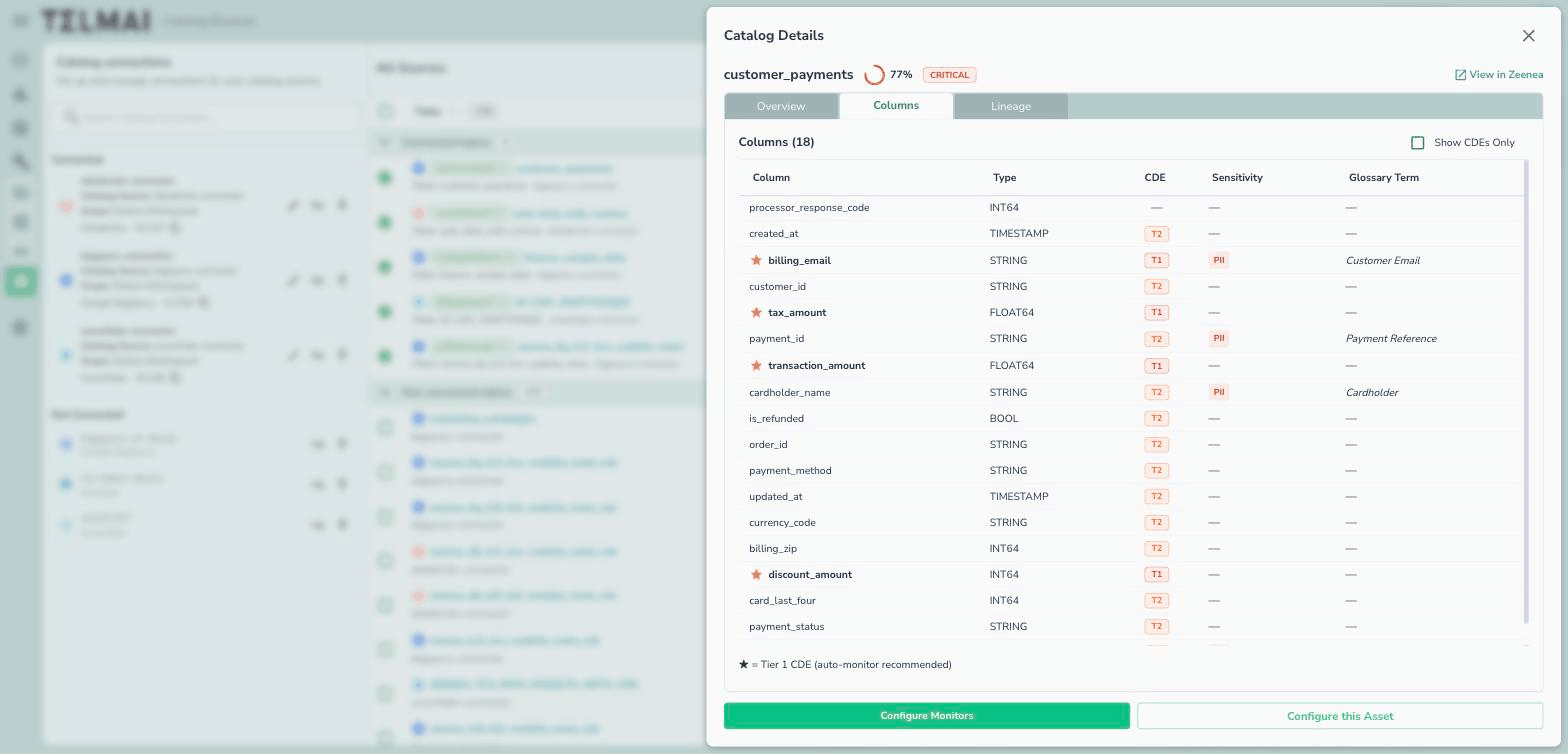
| Business glossary terms     | Informs AI-generated monitoring rules with business definitions |
| Lineage data                | Powers asset prioritization and lineage visualization           |
| Sensitivity classifications | Surfaces sensitivity context alongside monitors                 |
| Stewardship information     | Identifies the data steward responsible for each asset          |

<figure><img src="/files/ah7MC80mEjLcKGZkLHJE" alt="Catalog Details Columns tab showing CDE tiers, sensitivity classifications, and glossary terms per column"><figcaption><p>Column-level metadata from Zeenea: CDE tiers, sensitivity classifications, and glossary terms.</p></figcaption></figure>

{% hint style="info" %}
The Zeenea catalog integration is supported for the following Telmai data connection types: **BigQuery**, **Databricks**, **Snowflake**, and **OneLake**.
{% endhint %}

***

## Step 1: Create an API Key in Zeenea

Telmai authenticates to Zeenea with an API key. To create one:

1. In your Zeenea (Actian Data Intelligence) instance, go to **Administration > API Keys**.
2. Create a new API key and give it a descriptive name (e.g., `telmai-integration`).
3. Select the **scanner** permission for the key.
4. Save the key. Zeenea displays the secret once, inside a configuration snippet:

```hocon
api-key {
    secret = "eyJ0eXAiOiJKV1QiLCJhbGciOi..."
}
```

{% hint style="warning" %}
When copying the API key into Telmai, copy **only the secret value** — the token between the quotation marks (it starts with `eyJ`). Do not include the surrounding `api-key { secret = "..." }` wrapper or the quotation marks themselves.
{% endhint %}

***

## Step 2: Connect to Zeenea

In Telmai, go to **Administration** and select **Catalog** from the left menu.

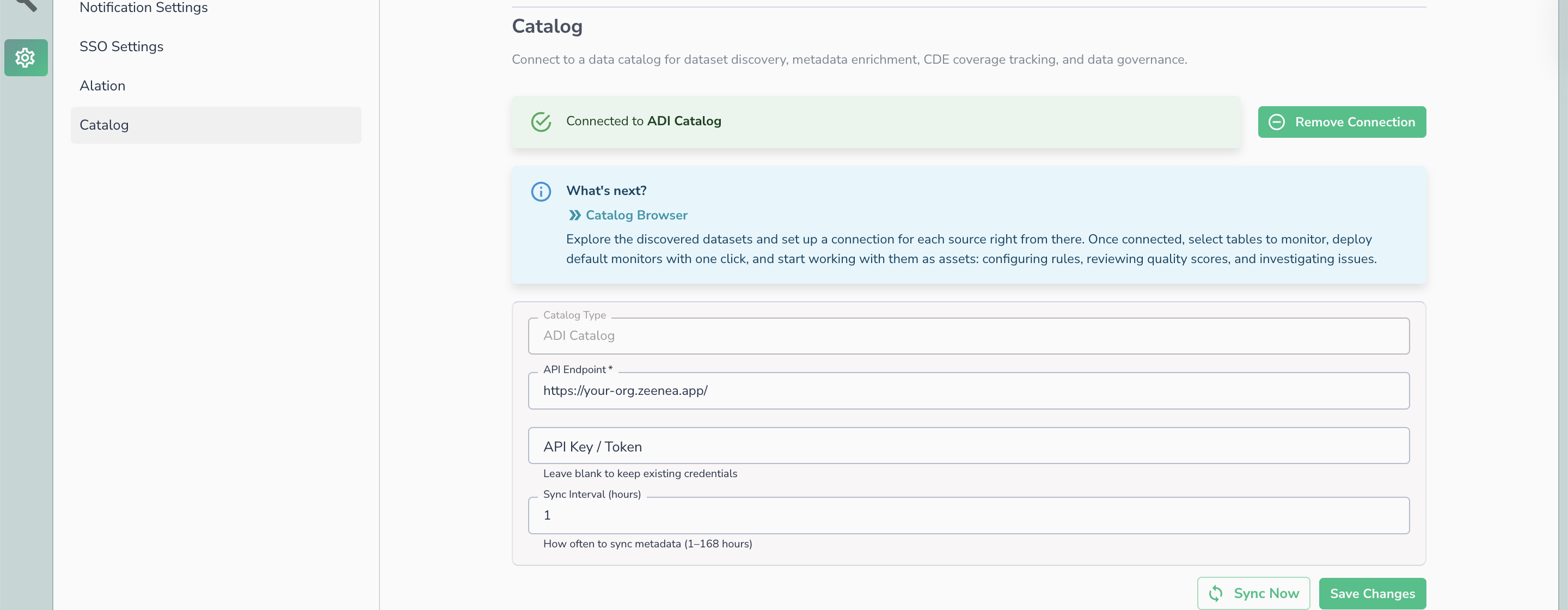
<figure><img src="/files/U8C6nrGALHnFzRVhnJjT" alt="Administration > Catalog connection form"><figcaption><p>The Catalog connection form in Administration, showing Catalog Type, API Endpoint, API Key/Token, and Sync Interval.</p></figcaption></figure>

Enter the following details:

| Field                 | Description                                                                                                                                                               |
| --------------------- | ------------------------------------------------------------------------------------------------------------------------------------------------------------------------- |
| Catalog Type          | ADI Catalog (preset for Zeenea)                                                                                                                                           |
| API Endpoint          | Your Actian Data Intelligence instance URL (e.g., `https://your-org.zeenea.app/`)                                                                                         |
| API Key / Token       | The API key secret created in Step 1 (only the token value, not the full `api-key { ... }` snippet). Leave blank when updating other fields to keep existing credentials. |
| Sync Interval (hours) | How often Telmai syncs metadata from Zeenea. Accepts values between 1 and 168 hours.                                                                                      |

Save the connection. Once connected, Telmai displays **Connected to ADI Catalog** and two additional actions become available:

* **Sync Now** — triggers an immediate metadata sync
* **Remove Connection** — disconnects Telmai from Zeenea

{% hint style="info" %}
After connecting, go to **Catalog Browser** to explore discovered datasets and link them to your Telmai data connections.
{% endhint %}

***

## Step 3: Catalog Browser

**Catalog Browser** is available in the sidebar under **Configure**. It is the central place for browsing catalog-discovered datasets and managing which tables are connected for monitoring in Telmai.

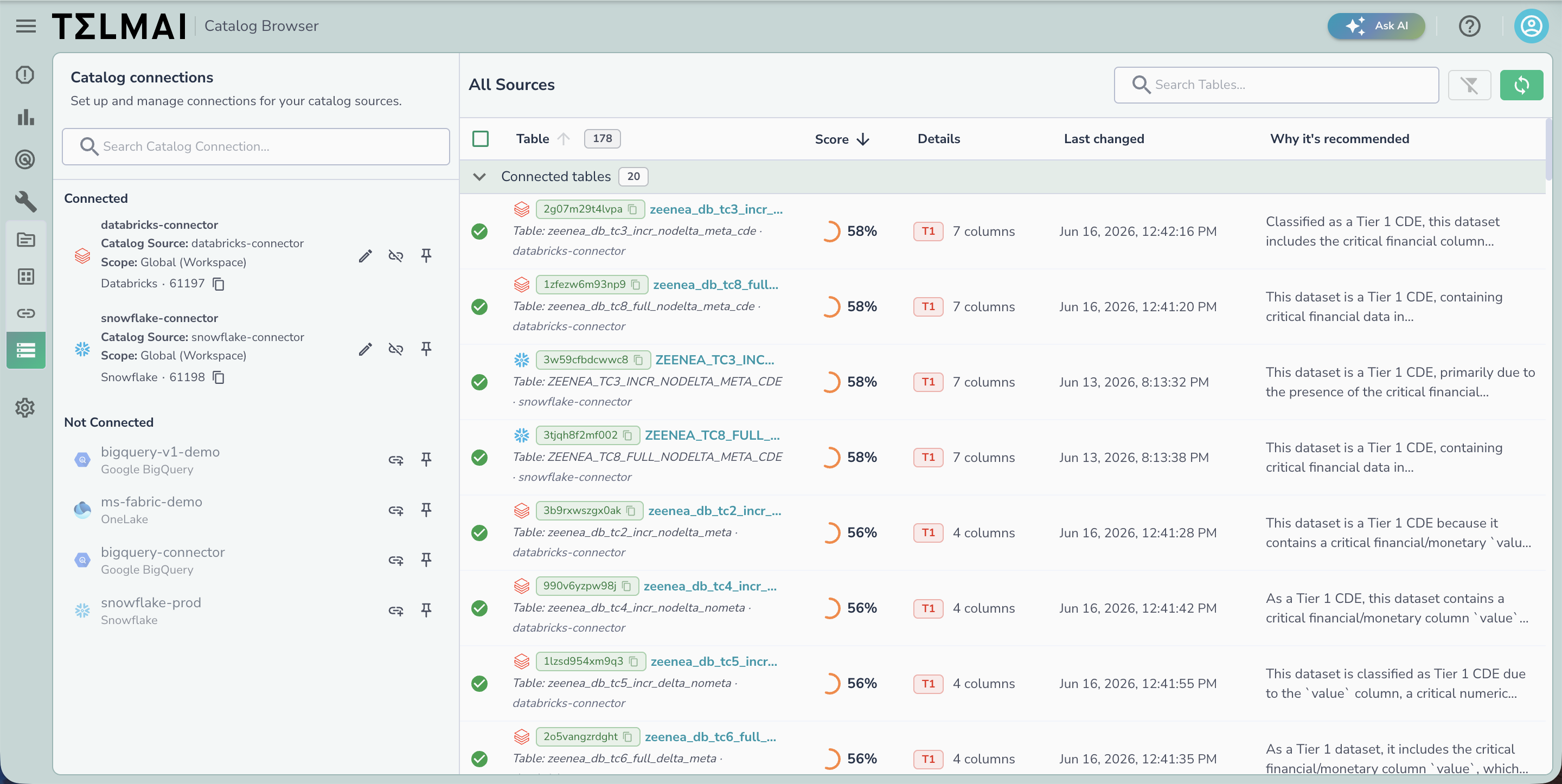
<figure><img src="/files/hnBnzrrpAuwVXtW4J3CM" alt="Catalog Browser"><figcaption><p>The Catalog Browser, with catalog connections on the left and discovered sources on the right.</p></figcaption></figure>

### Catalog Connections

The left panel lists your Telmai data connections and their catalog link status:

* **Connected** — the Telmai connection is linked to a catalog source. Telmai maps catalog metadata to assets from this connection.
* **Not Connected** — the Telmai connection has not yet been linked to a catalog source.

Use the link icon next to each connection to associate it with the corresponding catalog source.

### All Sources

The right panel shows all tables discovered from the catalog. Tables are grouped into two sections:

* **Connected tables** — already linked to Telmai assets
* **Non connected tables** — discovered from the catalog but not yet monitored in Telmai

Each table shows the following columns:

| Column               | Description                                                             |
| -------------------- | ----------------------------------------------------------------------- |
| Score                | Current data quality score for the table                                |
| Details              | Number of columns                                                       |
| Last changed         | When the table was last updated in the catalog                          |
| Why it's recommended | AI-generated explanation of why Telmai recommends monitoring this table |

***

## Intelligent Recommendations

Telmai uses catalog metadata to prioritize which tables most need monitoring. The **Why it's recommended** column in the Catalog Browser surfaces this reasoning for each table, drawing on:

* Tier classification (e.g., Tier 1 critical data elements)
* Presence of sensitive or PII data
* Financial or business-critical context from the catalog
* Stewardship completeness

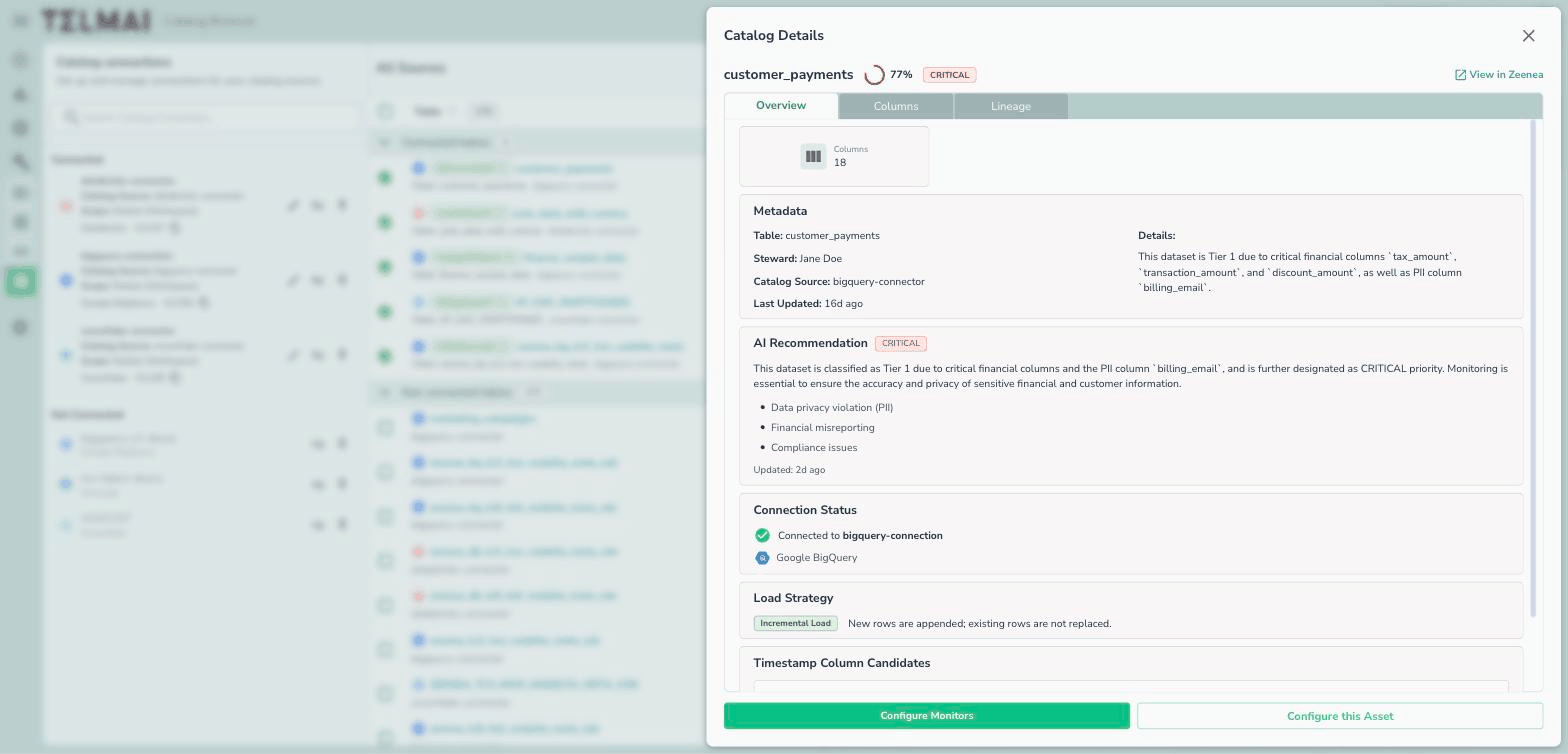
Select any table in the Catalog Browser to open its **Catalog Details**, which shows the dataset's catalog metadata, the full AI recommendation with its reasoning and priority, connection status, and suggested timestamp columns.

<figure><img src="/files/LnLQZfIM0tQGCIkoqcT5" alt="Catalog Details Overview tab showing metadata, AI recommendation with CRITICAL priority, connection status, and load strategy"><figcaption><p>The Catalog Details view, with the AI recommendation and its reasoning for a Tier 1 dataset.</p></figcaption></figure>

***

Metadata syncs on the interval configured in **Administration > Catalog**. Use **Sync Now** to trigger an immediate sync at any time.

***

## Business-Aware Rule Generation

When suggesting monitoring rules, Telmai uses the business definitions from the Zeenea glossary rather than relying on technical column names alone, making suggestions easier to evaluate and accept.

***

## Lineage Visualization

Telmai displays upstream and downstream data dependencies sourced from Zeenea lineage data, giving you context for how quality issues propagate through your data pipelines.